
Turn Off Lights
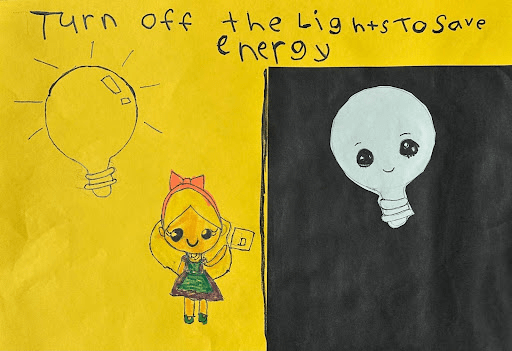
Artist info: Natalie L., Grade 2
A Simple Habit With A Powerful Impact
LEARN
What it is
Youth learn how conserving electricity can reduce energy waste by exploring CO₂ emissions and creating a family reminder sticker design.
Why it matters
Whenever you enter or leave a room—at home, school, sports practice, or anywhere—you have the power to help the planet by conserving electricity. Turning off lights reduces energy waste, lowers air pollution, helps slow climate change, protects animals and nature, and saves families and schools money.
Getting started
Time: 40 minutes
Grade level: 3–5
Materials:
- Lights Pledge Banner (see Facilitator Prep)
- Blank sticker paper – 1 per person
- Scrap paper and writing utensil – 1 per person
- Markers or crayons – several colors for everyone to share
- Earth On Us – Lights Off survey – 1 per person
- Writing utensil – 1 per person
- Optional: Calculators
- Optional: Lights Off stickers
- Optional Turn Off Lights sign: Post this in your program space, or pass out copies to youth to post in various places to encourage others to take the “Turn Off Lights” pledge!
Facilitator Prep:
- Youth will be signing the Lights Pledge Banner, so consider printing it out large, such as on an 11×17 piece of paper, or printing out multiple copies so that everyone has room to sign their names. Alternatively, you can reproduce your own banner on a large piece of butcher paper.
Background
Lights use electricity, and electricity doesn’t appear out of nowhere. Most of it comes from power plants that burn fuel, which releases pollution into the air. When lights stay on in empty rooms, energy is wasted—and so is the pollution created to power them. Turning off lights supports environmental goals by:
- Using fewer natural resources
- Reducing emissions from electricity production
- Teaching lifelong energy-saving habits
- Helping communities lower their carbon footprint
This small habit supports national energy-efficiency efforts and a cleaner planet.
What to do
Step 1: Learn why it matters (5 minutes)
- Ask youth, “Why do you think turning off the lights when you’re not using them is an important thing to do?”
- Ask youth to count how many lights in their house typically get left on.
- Add up everyone’s lights. Then divide this number by the number of people in the room, to get an average number of lights left on. We’ll use this for the next step!
- Let’s find out more!
Step 2: See the science (10 minutes)
- Explain that the electricity that powers your lights travels through a huge system:
Power plants → Wires → Neighborhood lines → Your home and school
- Per hour, 1 light emits 15 grams of CO₂. That’s like driving a car about a half a mile, or like the CO₂ you breathe out over 2 hours.
- Ask youth, “How much might we be wasting in our community? Let’s use our average number from Step 1 to calculate it.” Do the calculations together:
- Write the average number of light bulbs you calculated in Step 1.
- Multiply this by 15 grams of CO₂ (CO₂ produced per bulb each hour).
- Multiply that result by the number of people in the community (e.g., 500 in our school; or 50,000 people in our town, etc.).
- The result will show you how much CO₂ is emitted in one hour by this community.
- To compare to car emissions,
- Multiply the total by ½ (or divide by 2).
- The result tells you how many miles a car would need to drive to produce the same amount of CO₂.
- To help youth picture how many miles this represents, have a few familiar distances ready for comparison. For instance, if the total miles calculated was 37,500, and it’s 5 miles between my home and school, I could say that the amount of energy our community is wasting would be like driving back and forth between home and school 7,500 times (37,500 divided by 5).
- Explain that when we use more energy than we need, power plants must burn more fuel. That means more pollution, more greenhouse gases, and more harm to our environment. Saving electricity is one of the easiest ways kids can make a difference.
- Watch a short video, Energy Saving Tips for Kids — How to Save Energy, about how to save energy at home and why it matters.
- Have youth turn and talk to the person next to them about why electricity is important—and why it shouldn’t be wasted.
Step 3: Create your reminder (10 minutes)
- Ask youth how they think they could remember and help others in their family remember to turn off the lights. Every reminder helps families build good habits!
- Have youth draft a design for a reminder sticker that they can post in their home. Pass out scratch paper and a writing utensil for drafting the design. Encourage them to include a message, such as:
- “Lights Off!”
- “Save Energy!”
- “Flip the Switch!”
- “Earth First!”
- When they’re ready, pass out blank stickers for them to decorate using markers, crayons, or eco-friendly stickers.
- Encourage youth to place their finished sticker beside a light switch at home!
Step 4: Take the pledge (5 minutes)
- Make your promise to the planet! Sign your name on the Pledge Banner (see Facilitator Prep for banner preparation suggestions) to show your commitment and receive your sticker. Display it proudly at school or during your event to inspire others to join the movement!
- Go to EarthOnUs.org under Actions → Turn Off Lights, and make the pledge!
Step 5: Take the survey (5 minutes)
- Distribute the Earth On Us – Lights Off survey for youth to take.
Step 6: Celebrate! (5 minutes)
- Talk about it!
- Why is turning the lights off important?
- How will doing this make a difference in your home? In your community?
- You’ve made a difference! Remember, small actions lead to big impacts! By remembering to turn off lights, you’re helping reduce pollution and protect Earth every single day. Encourage your friends and family to do the same—and watch your impact grow.
Take it further
Your voice can motivate others! Share your story at earthonus.org to inspire youth around the world. Your story will be featured on the Earth on Us website to inspire other youth! Consider including:
- Event details (date, location, number of participants)
- Pictures (e.g., completed survey forms, signed pledge banner, decorated stickers, event pictures)
- A blog or summary about your event
♻️ Take the Pledge